
Start with what you want to get done.
There are two ways in. Pick the industry you are in, or pick the job you are trying to get done. This is the job list — growing a list, converting, keeping people, answering them, and the receipts and login codes underneath all of it.
Four stages of one customer.
Nobody wakes up wanting marketing software. They want a specific thing to stop being broken. Almost every one of those things sits at one of four points in the same relationship, and each point has a page below.
Attract
People visit and leave, and you have no way to reach them again. Landing pages, sign-up forms and on-site popups turn a visit into a contact you own. That is Grow your list.
Convert
You have contacts who have not bought yet, or a cart nobody came back to. Segments narrow the list, journeys send the follow-up on a delay. That is Convert and sell.
Serve
The reply, the question, the complaint, the order status — arriving on three channels at once. One shared inbox and a chatbot that hands off to a person. That is Support at scale.
Keep
The buyer who never came back. Date-based follow-ups, win-back campaigns and a points programme with tiers. That is Engage and retain.
The last two jobs are not a stage — they run underneath all four. Transactional messages are the receipts, order updates and alerts that have to arrive whatever else is happening, and one-time codes are the login and verification path. Both go out through the same account and the same reports as your campaigns.
Six jobs. One platform behind them.
Each page below is written for one outcome: what the problem looks like, which pieces of the product solve it, and what it takes to set up. Read the one that matches the thing that is broken right now.
Use cases or solutions — which list should you read?
The menu asks you the same question twice, in two different ways, and it is a fair thing to be confused by. Here is the difference in one table.
| Use cases | Solutions | |
|---|---|---|
| You arrive with | A job that needs doing | A trade you work in |
| Organised by | Outcome — grow, convert, retain, support, transactional, codes | Industry — e-commerce, retail, clinics, schools, couriers and more |
| Answers the question | How do I fix this specific problem? | How does a business like mine run this? |
| Best when | You know what is broken but not what to call it | You want the whole picture for your sector |
| Product behind it | The same account, channels and reports | The same account, channels and reports |
| Pricing | Identical — it never depends on which door you came through | Identical |
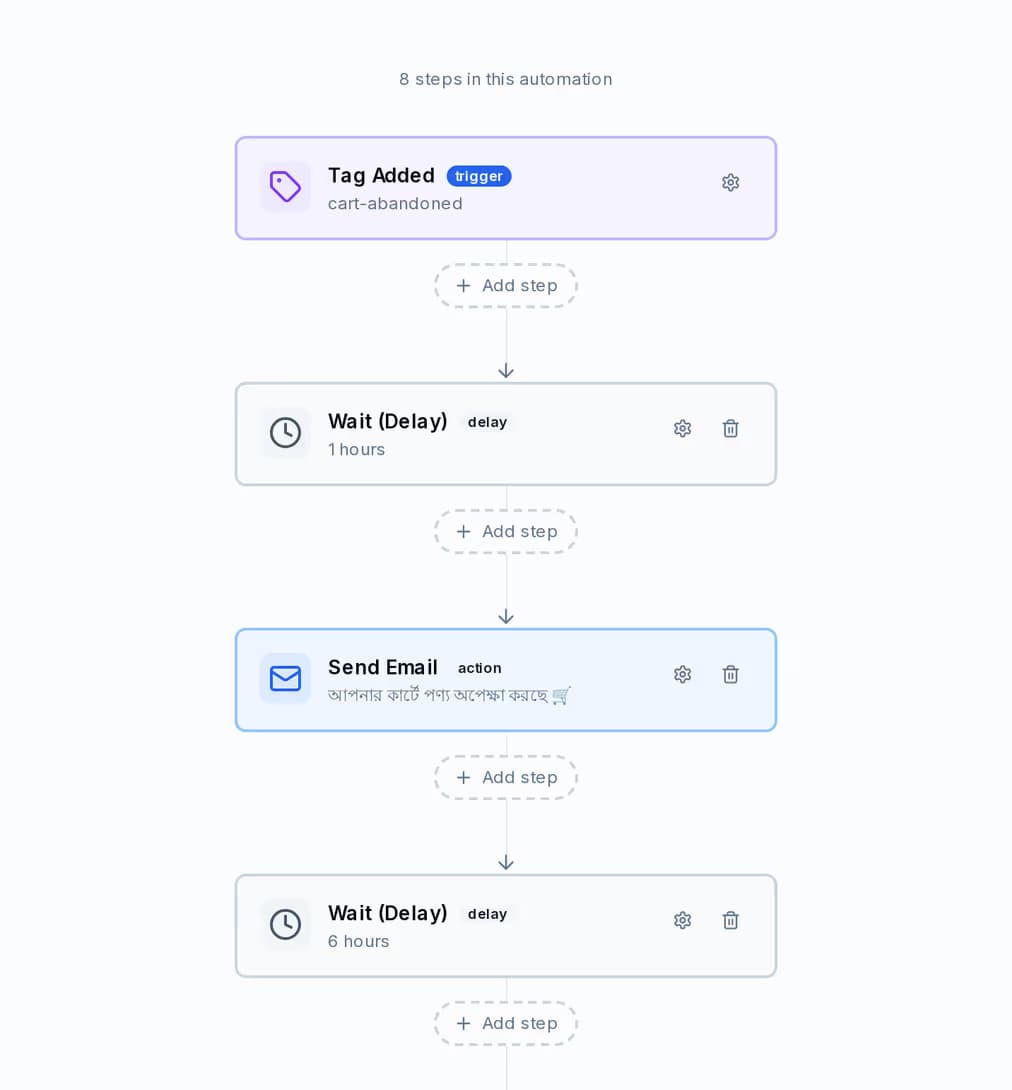
Different jobs, the same canvas.
Whichever page you pick, the machinery underneath is the same: something starts a journey, a wait passes, a message goes out, and a branch decides what happens next. The capture is a cart-recovery journey — one tag starts it, then email, WhatsApp and SMS with real delays in between.
- Journeys can start from a contact being created or updated, a tag added or removed, a form submitted, a campaign opened or clicked, a date being reached, or you starting it by hand.
- The date-based start is the one that runs entirely on its own: point it at a date on the contact — appointment, renewal, due date, birthday — and say how many days before or after.
- Steps can send on any channel, wait, add or remove a tag, update a field, split down a branch, or call your own system.
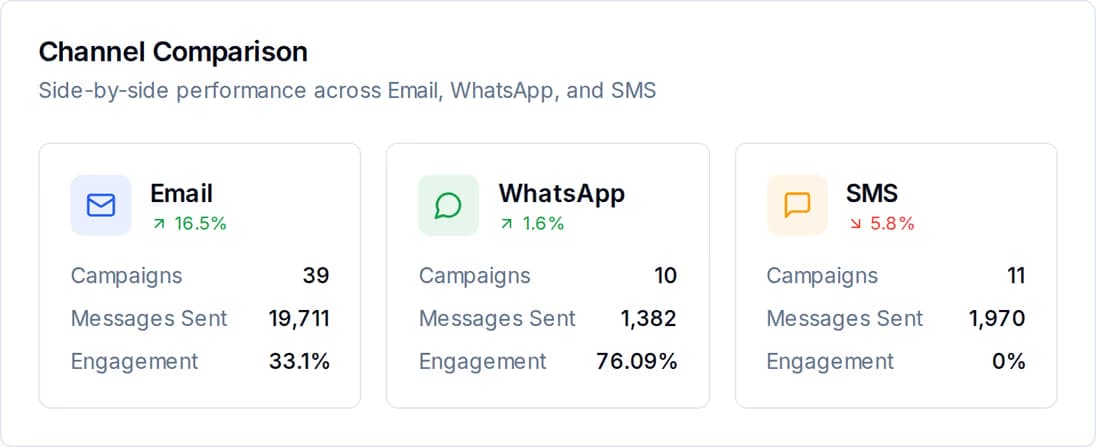
Every job ends in the same report.
You should not have to guess which job is paying for itself. All three channels report into one place, side by side, over the same window — so the question stops being what did we send and becomes what actually landed.
- Per message: sent, delivered, failed — with the reason and the code when it failed.
- Per campaign: the delivery funnel, engagement over time, and open rates ranked campaign by campaign.
- Push the same events into your own system as they happen — sent, delivered, failed, bounced.
What every one of these jobs is built from.
You are not buying six products. Everything below is in the account from day one, whichever job brought you here.
The three channels
- Email for bulk and transactional sends, through your own sending server or ours
- SMS in two forms — a branded sender name, or plain — each on its own volume slider
- WhatsApp on the official Meta connection, using your own business number
The pieces you build with
- Landing pages with A/B tests you start, stop and pick a winner on
- Embeddable forms — one small script on any site you already have
- On-site popups with conversion tracking
Guardrails that stay on
- Quiet hours: SMS and WhatsApp to a contact are held between 9pm and 8am Bangladesh time
- Per-contact frequency caps and a cooldown, so one contact cannot be buried
- Each brand kept separate from every other at the database level
The questions people ask at this page.
Can I do more than one of these?
Yes, and most businesses end up doing three or four. They are not separate products or separate accounts — the same contacts, the same inbox and the same reports serve all of them. Picking a page here is just choosing where to start reading.
Which one do most businesses start with?
Start where the leak is. If people visit and you have no way to reach them again, start with growing your list. If the list is fine but nobody buys twice, start with convert or retain. If your team is drowning in replies across three apps, start with support. If the messages that must arrive are the problem — receipts, order updates, login codes — start with transactional or one-time codes.
Do I need all three channels?
No. Each channel is bought on its own, so you can run a job on email alone and add SMS or WhatsApp later. SMS comes in two kinds — a branded sender name and a plain one — and WhatsApp is bought by message category, each on its own volume slider.
Whatever your goal, one platform gets you there.
Open an account, pick the job you came for, and add the rest when you need them.