
Shared inbox

Seven ways in. One list out.

WhatsApp, email, SMS, Telegram, Messenger, Instagram and the live chat on your own site all arrive in the same list. Every conversation carries a status, a priority, tags and the person who owns it — and your reply goes back out on the channel it came in on.

Reply goes back on the same channelOpen, pending, resolved, closedViewing and replying are separate permissions
Shared inbox — live
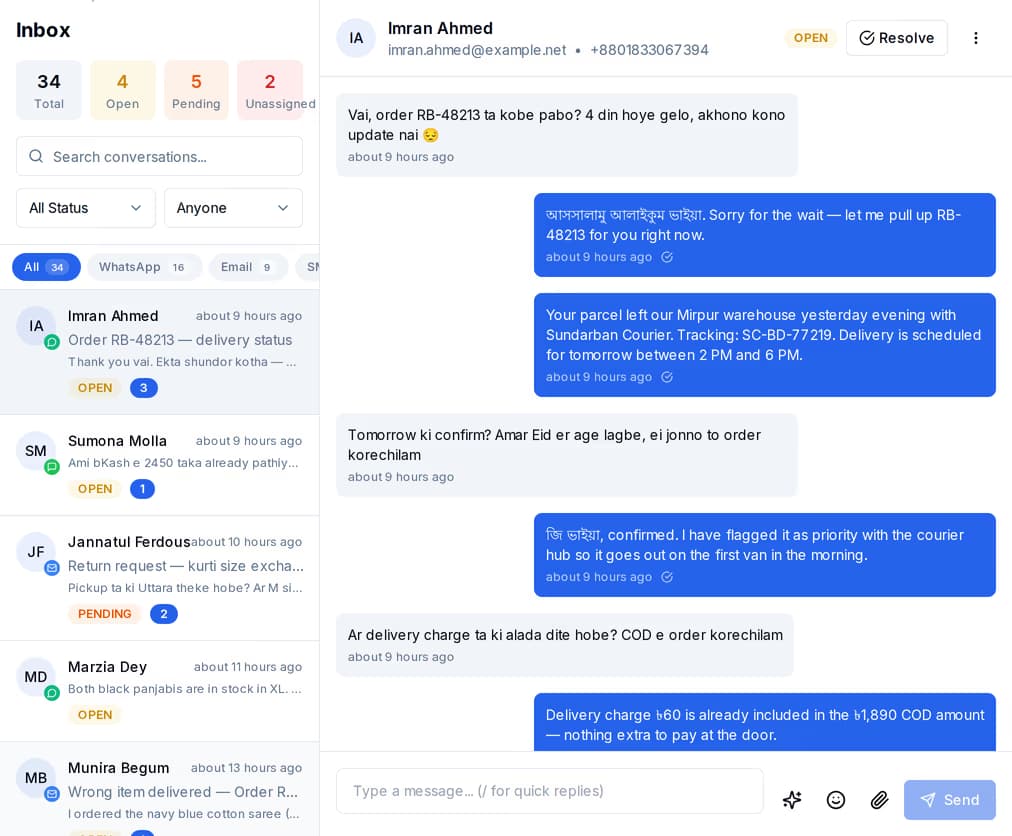
QuickGrow's shared team inbox: a conversation list filtered across WhatsApp, Email and SMS with unread badges, beside an open WhatsApp thread where an agent answers a customer's order-tracking question in Bengali and English.

Three panels, and everything about a conversation lives in one of them.

The inbox is not a feed you scroll and hope. It is a queue with a size, a list you can narrow down, and a thread with the facts about that customer sitting next to it. Here is what each part is for.

The counts, at the top

  • Four numbers above the list: everything, open, pending, and how many nobody has picked up.
  • Under them, a rail with one tab per channel and the number of conversations on it.
  • A channel tab only appears once that channel has conversations, so the rail never fills with tabs you do not use.

The list, down the left

  • Newest activity first, whichever channel it came in on, with the channel marked on each row.
  • Unread conversations are marked as unread until somebody opens them.
  • The whole list is live: a new conversation, a new reply or a reassignment appears without a refresh.

The thread, and the panel beside it

  • The full back-and-forth with that person on that channel, oldest at the top, in one scroll.
  • A reply box under it, with your saved answers and a drafted reply a click away.
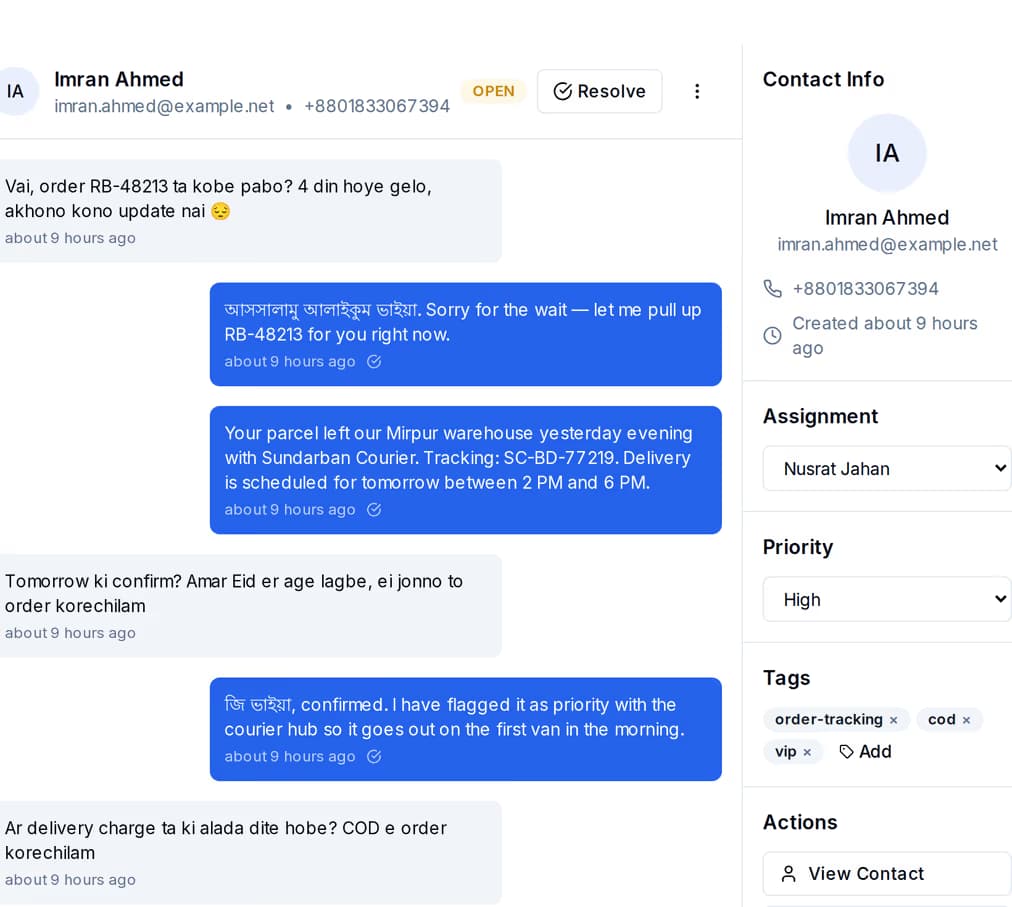
  • To the right: who owns it, its status, its priority and its tags — all changeable from there.

If what you want is the support side of this — who owns which question, how the day gets cleared, what the bot takes off you — read the support write-up. This page is about the surface itself.

Seven ways a customer can reach you, and what you can send back on each.

They all land in the same list and they all reply in the same box, but they are not identical on the way out. This is the honest difference, so nobody promises a customer a file on a channel that will not carry one.

WhatsApp, Messenger and Instagram carry Meta’s 24-hour reply window: once more than 24 hours have passed since the customer last wrote, a free-form reply can be refused and an approved template is needed instead. The reply box warns you before you start typing.
How it arrivesWhat your reply goes out asFile with the reply
WhatsAppFrom your connected WhatsApp Business numberText, plus a photo, video, document or audio fileYes
EmailA reply to an address on a sending domain you have verifiedText, on your own mail server or oursNo
SMSA text to your inbound numberPlain textNo
TelegramA message to the bot you connectedTextNo
Facebook MessengerA message to the Page you connectedTextNo
InstagramA direct message to the account linked to that PageTextNo
Live chatFrom the chat widget on your own websiteText, straight back into the widgetNo

Four steps, and the setup walks you through all four.

There is a guided run-through in the product for exactly this, and it will not call you live until a channel is actually connected and somebody is on it.

  1. Connect a channel

    Point a WhatsApp Business number, a mail domain, an SMS number, a Telegram bot or a Facebook Page at QuickGrow. The inbox stays shut until at least one of them is connected, and it tells you which are still missing.

  2. Put people on it

    For each connected account, choose which teammates work it and how new conversations are handed out — to whoever has the fewest open right now, round the group in turn, or to nobody until somebody picks it up.

  3. Save the answers you repeat

    Write your standard replies once — delivery times, return rules, where the shop is, the account number — give each a short name, sort them into categories, and pick which channels each is allowed on.

  4. Go live

    From then on, every message on those channels lands in the same list for everyone who has been let in. Nobody watches a phone, and nobody logs into four apps to find out what was asked.

A conversation is in one of four states — and the customer moves it for you.

Open is anything live. Pending is what you are waiting on somebody else for. Resolved and closed are done. The counts above the list follow whatever you set, so the size of the day is never a guess.

A WhatsApp conversation open in the QuickGrow inbox, with the panel beside it showing the conversation status, priority, tags and the teammate it is assigned to.
The panel beside the thread

Set it once, and it stays on the conversation for everybody.

Status, priority, owner and tags all live in the same panel next to the messages. Anyone with reply access can change them, and the change is on the conversation for the whole team a moment later — not in somebody's head, and not in a separate tracker you have to keep in step.

  • A message from the customer on a live conversation puts it back to open, marks it unread and lifts it to the top — so one you parked as pending comes back on its own the moment they reply.
  • Once you have marked it resolved or closed, their next message starts a fresh conversation on that channel and the finished one keeps its whole history.
  • Priority runs low, normal, high and urgent, and shows on the conversation for everyone.

A shared inbox is only safe if the sharing has edges.

Putting a new person on the inbox should not hand them your whole contact list and a send button. It does not have to, and by default it does not.

Two permissions

Reading it and answering in it are separate

One permission opens the inbox. A second one lets a person reply, assign, tag, and change a status. Give somebody the first and they can read every conversation without being able to send a word — which is exactly what you want for whoever is only reporting on it.

A role for it

Inbox Agent is ready before you set anything up

Four roles are seeded with your account, and one of them does the inbox and nothing else: read conversations, reply to them, look up a contact. It cannot send a campaign to your whole list and it cannot export your contacts. A new starter can be answering customers on their first morning.

Per connected account

Each channel has its own team and its own rule

Hand-outs are set on the connected account, not once for the whole business. The WhatsApp number can go to the shop team on a rota while the support mailbox goes to whoever is least busy, and a third channel stays manual. Reassign any single conversation by hand whenever you like.

Three ways to stop retyping the same paragraph.

None of these send anything on your behalf. They put words in the box; a person still presses send.

Saved replies

The five answers you type every day, typed once

Store an answer, name it, sort it into a category and choose the channels it can be used on. Open the list from the reply box and pick one; the text drops straight into the box. It goes in exactly as you wrote it — nothing is filled in for you — so add the name, the order number or the date before you send.

A drafted reply

A first draft when you are staring at a hard one

One button reads what the customer just asked, works out what they are after, and puts a suggested reply in the box. It is a draft and nothing more: you read it, change it, and send it yourself. Nothing goes out that a person did not press send on.

Inbound SMS keywords

Some replies do not need a person at all

Register words for your inbound SMS number, including the opt-out words people actually use. A match is recorded against the message so you can spot it, and the message lands in the inbox either way — acting on an opt-out is a step someone takes rather than something that happens on its own.

A chatbot can take the first round entirely and hand over the moment it is out of its depth — see how the handover works. The 24-hour rule on WhatsApp, and what it means for replying, is on the WhatsApp page.

Before you move your messages onto it.

Which channels really land in this inbox?

WhatsApp, email, SMS, Telegram, Facebook Messenger, Instagram direct messages, and the live chat widget on your own website. Each gets a tab with a count beside it, and a tab only shows once that channel has conversations. At least one channel has to be connected before the inbox will open — it will not show you an empty screen and leave you guessing.

Does my reply go back out on the same channel?

Yes. Whatever you type in the reply box goes out over the channel that conversation is on, from your own connected number, bot, Page or mail domain. There is no copying an answer into another app, and the customer sees it arrive where they wrote to you.

Can I send a photo or a document with a reply?

On WhatsApp, yes — a photo, a video, a document or an audio file goes out attached to your reply. On the other channels the reply itself goes as text, so send a link if the customer needs a file. Files a customer sends you are shown in the thread whatever channel they came in on.

How do I find a conversation from last month?

Filter the list by status, by the person it is assigned to, or by channel from the rail across the top. The search box matches the subject of a conversation. Tags are the reliable way to find things again later, so tag the ones you know you will want — refund, wholesale, complaint — and they stay on the conversation for good.

Somebody writes in who is not one of my contacts. What happens?

The conversation opens anyway. A contact is created from the number or email address they wrote from and marked as unknown, so nothing is dropped while you work out who they are. If they write again from the same number or address, it joins the same person rather than starting a stranger from scratch.

How many people can work the inbox?

Your plan sets how many team members the account can have. Every one of them can be given inbox access, and you decide per person or per role whether they can only read or also reply. Removing someone leaves their conversations in place, ready to hand to somebody else.

What happens when a chatbot is answering and the customer wants a person?

The chat is handed to a teammate who has marked themselves available — the one with the fewest open conversations — and the customer is told by name who has taken it, in the same thread. If nobody is free, the conversation is parked as pending with its place in the queue, and everyone on the account is alerted. When it is settled it can go back to the bot in one action.

Is the inbox extra, or part of the platform?

It is part of the platform fee, along with the saved replies, the roles and the chatbot handover. What you pay on top is the sending on each channel — and if you bring your own mail server, SMS account or WhatsApp number, you pay the platform fee only and settle the traffic with your provider. The inbox works the same either way.

Put every channel your customers use into one list.

Connect a channel, choose who works it and how new conversations are handed out, and answer WhatsApp, email, SMS, Telegram, Messenger, Instagram and website chat from the same box.