Plain English only
160characters per part
A–Z, digits and basic punctuation. 200 characters becomes 2 parts.
Reach every phone in Bangladesh — masking or non-masking, priced by message part, with quiet hours and per-customer limits built into the send.
The reply comes back into your shared inbox as a conversation, not to a phone on someone's desk.
This is the part most SMS sellers in Bangladesh leave you to work out for yourself. Non-masking means the message arrives from a number. Masking means it arrives from your brand name — up to 11 characters — and that name has to be approved before it can be used. Each has its own volume slider, and you can buy volume on both.
| Non-masking | Masking | |
|---|---|---|
| What the customer sees | A phone number | Your brand name, 1–11 capital letters and digits |
| When you can start | As soon as your volume is active | After the sender name is approved |
| What you submit | Nothing | Trade licence, TIN, business address, an authorised contact, sample messages |
| Before approval comes through | Not applicable | Sends go out on the default sender instead |
| Usually used for | Offers, reminders, notices | Order updates and codes, where the customer needs to know it is really you |
| Its own volume slider | Yes | Yes |
A masking sender ID is an application, not a setting. You fill in real business details, they go to the SMS gateway, and the name only becomes usable once it clears. Plan for it before the campaign you want it for.
We text a six-digit code to the authorised person’s number. It is valid for ten minutes, with five tries.
Brand name, business type, trade licence number, TIN (and BIN if you are VAT-registered), address, an authorised contact with NID, the sender ID you want, what you will use it for, up to three sample messages, and your expected monthly volume.
We register the sender ID upstream and track its state for you. You declare that the traffic is local and accept the sender terms as part of submitting.
Once your details and the gateway both clear it, the name can be picked on a campaign. Until then, and if approval is ever withdrawn, sends fall back to the default sender. A rejection comes back with the reason so you can fix it and submit again.
SMS is billed by the part, not by the message. Plain English fits 160 characters in a part. The moment a message contains a single Bangla letter — or a taka sign, or an emoji — the whole message drops to 70 characters per part. Nobody tells shop owners this, and it is the difference between one charge and three.
A–Z, digits and basic punctuation. 200 characters becomes 2 parts.
One Bangla letter anywhere sets the whole message to 70. 140 characters becomes 2 parts; 210 becomes 3.
The count runs over the finished message, so a link or a shop name pushes it further than you expect. Writing in English, or keeping the Bangla version short, is a real saving on a list of any size.
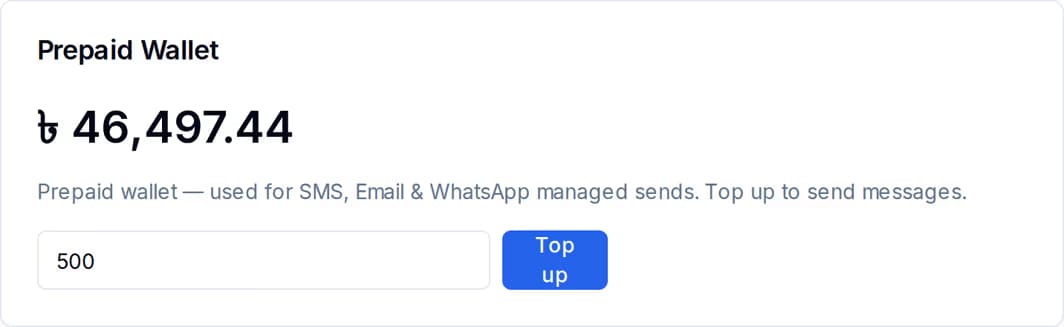
There are two ways to run SMS on QuickGrow, and they cost you differently. Take managed volume and we handle the gateway — each part is priced and taken from your prepaid balance before it goes out, so you can never send more than you have paid for. Already have a gateway contract you like? Put your own credentials in and QuickGrow sends through them instead.
SMS keeps its own list and its own saved audiences, separate from your email and WhatsApp contacts — so an SMS campaign never accidentally goes to someone who only ever gave you an email address.
Numbers with a name, a source, tags and the date they opted in. Search and filter the list, and export it whenever you want a copy.
Build a rule from whether someone is active, where they came from, their tags, how engaged they are and when they were added. Check how many people match before you save it.
Save a message once and reuse it on any campaign, or type a one-off message straight onto the campaign itself. Duplicate a template to start a variation.
Set a date and time and the campaign fires itself — checked every minute. Pause a send midway, resume it, cancel it, or duplicate the whole thing for next month.
There is no test-send button. Before a big send, make a segment that matches one number you own and send to that first — it is the same path a real campaign takes, so what you see is what your customers will see.
These are enforced in the code that dispatches a message, so they hold whether the send came from a campaign, a journey or your own software. Some of them will surprise you — better here than after a complaint.
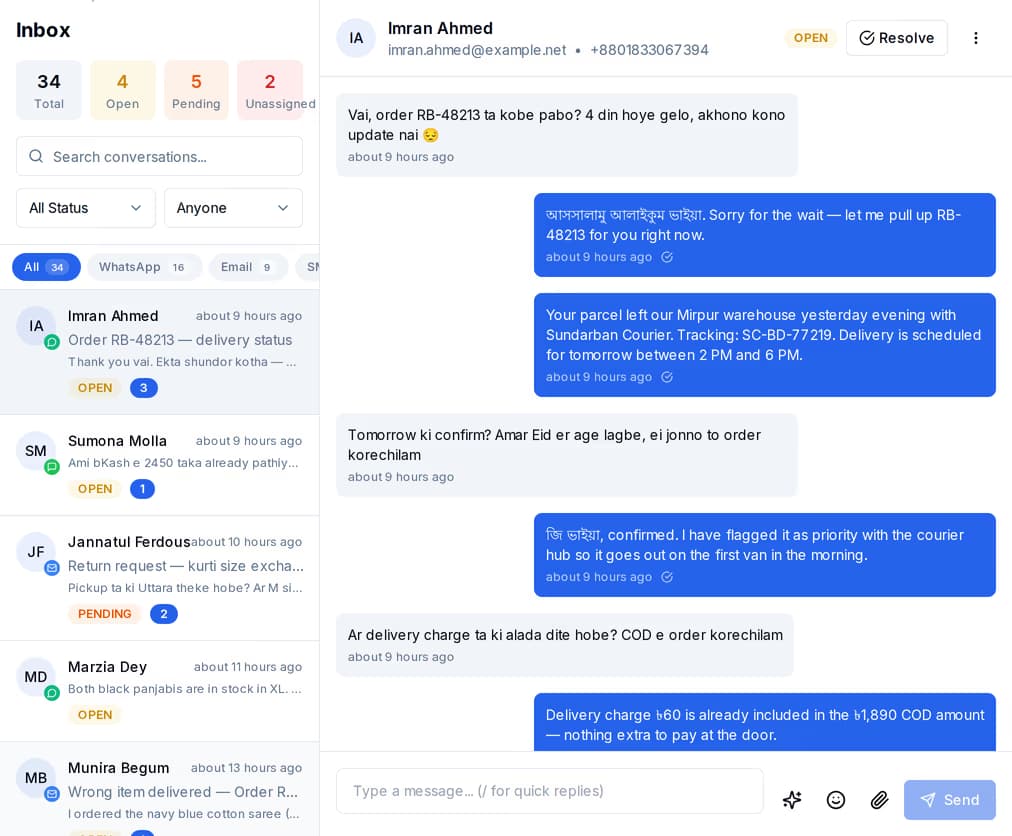
When a customer texts back, the message is routed into the same shared inbox your team uses for WhatsApp and email, as an open conversation against that person. Your team is notified, someone answers, and the thread stays in one place — you are not logging into a gateway portal to read replies.
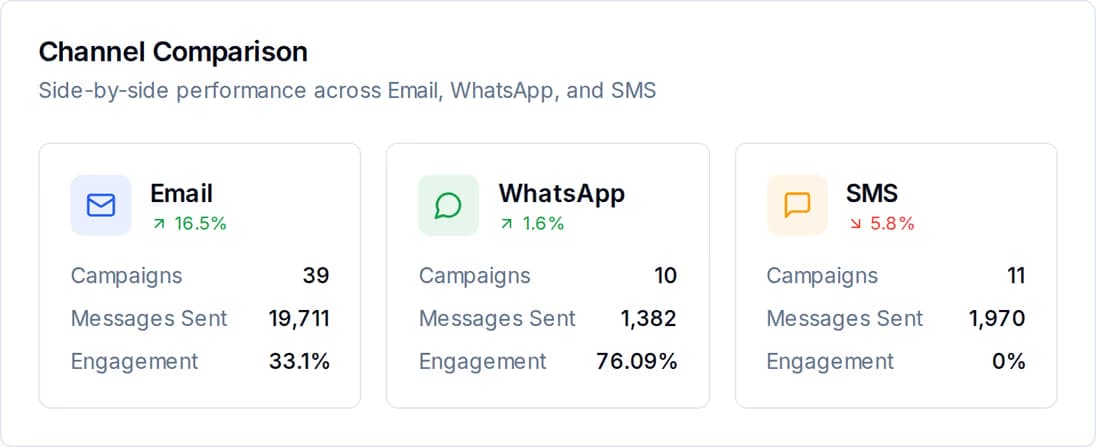
Every recipient of a campaign has its own row: queued, sent, delivered or failed, with the time and — when it failed — the reason the network gave. The campaign totals add up from those rows, and the reports section puts SMS beside your other channels so you can see where your messages are actually going.
Most businesses start with non-masking because it works the day you buy it, then add masking for the messages where the customer needs to trust the sender — order updates, codes, payment notices. They have separate volume sliders, so buying both is a normal thing to do rather than a mistake.
It is not instant and it is not in our hands alone — the sender ID has to clear the SMS gateway as well as our own check of your documents. Submit the application before you plan the campaign that needs it. Until it is approved, campaigns that pick that sender still go out, but on the default sender rather than your brand name.
Because a message with any Bangla character in it fits only 70 characters per part instead of 160, and you are billed per part. A 200-character Bangla message is three parts. The same message written in English would be two. A single taka sign or emoji has the same effect as a full sentence of Bangla.
Non-masking works from day one. Start the masking application in parallel and your brand name is ready when you need it.
 CyberCraft BangladeshQuickGrow AI
Run every channel from one platform. Bring your own SMTP, SMS gateway, and WhatsApp number — or use ours.
See pricing →