The invoice is in Taka
Taka is not a converted display price. Plans carry their own Taka figure alongside the dollar one, so what you see is the number you are billed, in the currency your books are already kept in.
QuickGrow AI is built by CyberCraft Bangladesh. This page is what we are prepared to put in writing: what the product is for, the choices underneath it, and the list of things we will not claim — starting with the fact that we hold no security certification of any kind.
They assume a dollar invoice, an English-reading customer and an email-first habit. Four things about talking to customers here are different enough to change the product itself, not just the price list.
Taka is not a converted display price. Plans carry their own Taka figure alongside the dollar one, so what you see is the number you are billed, in the currency your books are already kept in.
This site is published in English and Bangla, and the language you choose changes the address you are on rather than hiding behind a cookie. Nothing here assumes English is the comfortable option.
To send SMS under your business name instead of a shared number you submit one to eleven letters or digits and wait for approval. Until it comes through, your messages go out from the default sender — and the product tells you that, rather than pretending the switch was instant.
Not a channel to add later. QuickGrow runs on the official Meta Cloud API, and Meta bills every template category — utility, authentication and marketing — straight to your own payment method, at Meta's own rate. QuickGrow adds zero markup.
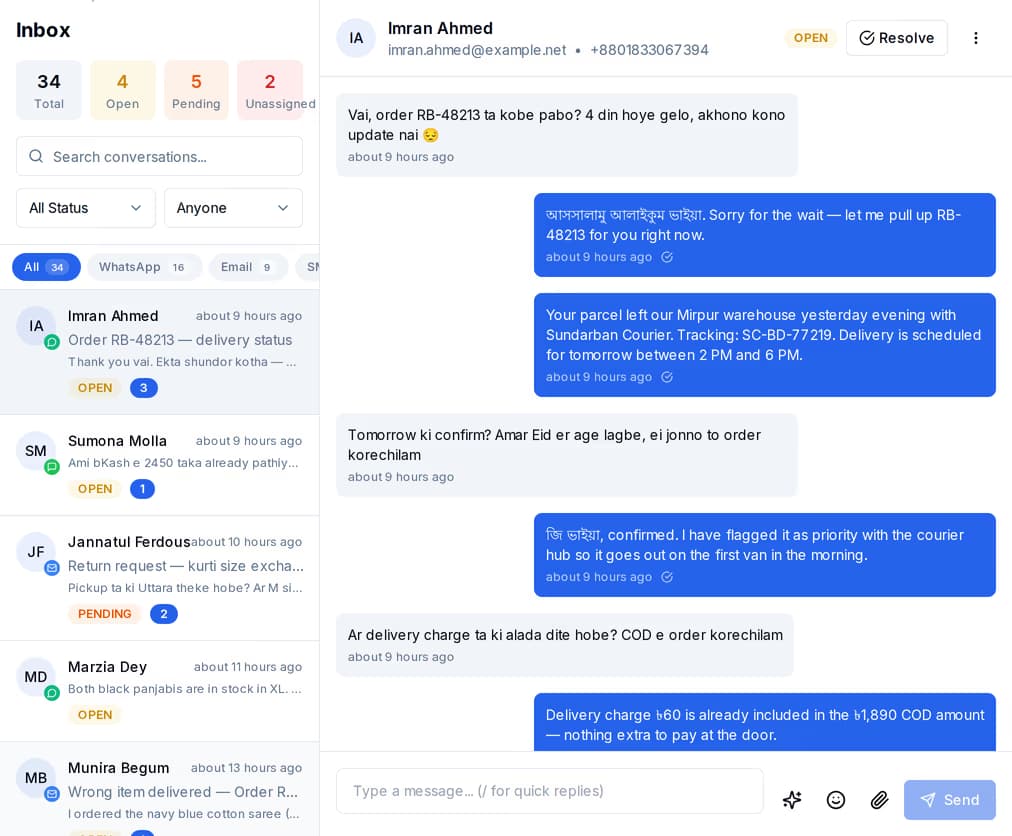
Three channels in one product is not three tools sold behind one login. Email, SMS and WhatsApp keep their own queues, providers and templates, because they genuinely are different things — but they share one contact list and one inbox your team answers from. That is the reason the product exists. Everything below is downstream of it.
These are not values on a wall. Each one is a thing the product does, and each one costs us something — which is the only reason it is worth telling you about.
Your own outgoing mail server, your own SMS gateway, your own WhatsApp number — a first-class setup, not a grudging fallback. Do that and you pay the platform fee and nothing per message. Buy managed volume instead and the fee shrinks; buy enough of it across all three channels and it goes entirely.
Every account gets the whole product — automations, the shared inbox, the analytics, the API. A plan decides how much volume it covers, not which screens you are allowed to open. You will not hit an upgrade prompt sitting on top of the feature you already decided you needed.
Each brand you run is its own tenant, and the database itself refuses to hand one brand’s records to another. An agency with six clients, or a group with six branches, gets six real boundaries rather than a filter somebody could forget to apply.
A public API whose reference you can read without an account, SDKs, and a Partner API that lets an agency create and run client accounts from its own system. This is something to build on, not a screen you are meant to live inside.
Two of those have their own page. Agencies and resellers run client accounts under their own name through the partner programme, and anyone can refer a business — they begin with a welcome credit and you earn credit once they pay. The amounts are ours to set and they change, so they live on that page and not in a sentence here.
A platform that will happily fire a promotion at 11pm is not doing you a favour. These are checked on the way out, not written into a policy document and left to you to remember.
| Enforced | What that means for you | |
|---|---|---|
| Overnight quiet window on SMS | Yes | Anything addressed to one of your contacts is blocked overnight. One-time codes and order updates included — there is no exemption, so do not design a flow that depends on one going out at midnight. |
| Overnight quiet window on WhatsApp | Yes | The same window, checked on the same send path, with the same lack of an exemption. |
| Overnight quiet window on email | No | Email is not gated at all. Send it whenever you like — and schedule it if you would rather not. |
| Recorded consent before an SMS goes out | Yes | An SMS to somebody with no consent on file is refused outright. An inbound STOP is recorded and flagged, but acting on it is a step someone takes — it is not automatic today. |
| Per-contact limits and a cooldown on SMS and WhatsApp | Yes | Platform-wide defaults rather than a dial you turn, so one over-eager campaign cannot bury one person. |
| A branded SMS sender name you can use straight away | No | One to eleven letters or digits, submitted as an application. Until it is approved, your sends fall back to the default sender. |
| WhatsApp templates submitted to Meta on your behalf | No | You draft the template here, approve it inside your own WhatsApp Business account, and sync the result back. We do not submit it for you and will not say we do. |
| A failed WhatsApp message re-sent as an SMS | No | No. The send stops. WhatsApp is billed by Meta directly, not from a QuickGrow wallet, so there is nothing on our side to refund — you get the delivery state and the failure reason instead of a silent second charge on another channel. |
An about page is usually where a company acquires a founding story, a headcount and a wall of customer logos. This is the whole of what we will actually put in writing — and the list of what you will not find, because we have no honest source for it.
CyberCraft Bangladesh. That is the company behind the product and the name on the legal pages. We do not publish a headcount, a founding date or an office address anywhere on this site, which is why you will not find them invented on this page either.
It is built for Bangladesh first: Taka pricing, the local overnight quiet window, the sender-name approval, WhatsApp treated as a primary channel rather than an add-on. Nothing stops a business elsewhere using it — quiet-hour windows are held per country, and plans are priced independently in each currency the platform supports.
No. Nothing in the product is switched off on a smaller plan — the automations, the shared inbox, the analytics and the API are the same on every one of them. What a plan sets is how much volume it covers. The platform fee then shrinks as you buy managed volume, and a long enough billing term discounts the fee and the volume on their own separate ladders.
Everything on this page is something you can go and check. Build a plan, read the security page, open the API reference — or just create an account and connect a channel.
 CyberCraft BangladeshQuickGrow AI
Run every channel from one platform. Bring your own SMTP, SMS gateway, and WhatsApp number — or use ours.
See pricing →